What You Will Find Here

My photo
Articles and news of general interest about investing, saving, personal finance, retirement, insurance, saving on taxes, college funding, financial literacy, estate planning, consumer education, long term care, financial services, help for seniors and business owners.

READING LIST

Blog List

Showing posts with label widows. Show all posts

WIDOWS BENEFITS FROM Social Security (BANKRATE.COM)

Wife: What are my rights in claiming my deceased husband's Social Security?

Don TaylorDear Senior Living Adviser,
My husband died in February 2002 at the age of 61. I turned 60 years old in February of 2011. I was recently told that, as of age 60, I could've started collecting benefits on my husband's earnings, then on my own earnings once I turn 66.
Is this correct and is it too late for me to do this?
Yours truly,
-- Judith Jumpstart
Solemn older woman looking upwards | Luc-Richard Photography/Getty Images
Luc-Richard Photography/Getty Images
Dear Judith,
Absent children at home, a spouse can claim a survivor's benefit at age 60, or age 50 if the surviving spouse is disabled. The benefit is a reduced benefit when it's claimed prior to the surviving spouse's full retirement age. You'll be turning 65 in February 2016, but your full retirement age is 66.

Retro payments of survivor's benefits?

The Social Security Administration limits retroactive payments of survivor's benefits prior to full retirement age in most cases to 6 months' worth of benefits. The maximum is 12 months.
If you work while getting Social Security survivor's benefits and are younger than full retirement age, your benefits may be reduced if your earnings exceed certain limits.
According to the Social Security Administration, "If a person receives widow's or widower's benefits and will qualify for a retirement benefit that's more than their survivor's benefit, he or she can switch to their own retirement benefit as early as age 62 or as late as age 70. The rules are complicated and vary depending on the situation, so talk to a Social Security representative about the options available."  

Read more: http://www.bankrate.com/finance/retirement/rights-claiming-social-security-widow-benefits.aspx#ixzz416ETXrzI


ETIREMENT

Social Security survivor benefits for widows and widowers


Survivor benefits guide for widows, widowers | RubberBall Productions/Brand X Pictures/Getty Images

Benefits guide for widows, widowers

Losing a spouse to death leaves people with a devastating hole in their lives, but that hole may feel even deeper if their financial security disappears at the same time.
About 53% of married couples rely on Social Security for 50% or more of their income, and 22% of couples depend on it for 90% or more, according to the Social Security Administration.
"When you are widowed, that means you are only going to get 1 Social Security benefit. If you are just making it on 2 benefits, then you are going to be up a creek when you lose 1," says Cindy Hounsell, an attorney and president of the Women's Institute for a Secure Retirement.
Given both the unpredictability and the inevitability of death, planning for the time when death takes a deep cut in Social Security benefits is wise.
Here are 6 factors to consider about Social Security survivor benefits while you are still able to make plans to maximize what a surviving spouse can collect.

9 months of marriage is required -- mostly | Marc Debnam/DigitalVision/Getty Images

9 months of marriage is usually required 

You must be married 9 months to claim Social Security survivor benefits -- with a few exceptions.
Survivor benefits are also available to those married for less time than that in a few cases, including the following:
  • The survivor is the parent of the deceased's minor child.
  • The death was accidental.
  • The deceased died in the line of active military duty.
Suicides don't count.
Also, if the couple was previously married for at least 9 months, divorced, then remarried with the reasonable expectation that the deceased would survive 9 months, the widow or widower may also qualify for survivor benefits.

Patience is (generally) a virtue | Nils Hendrik Mueller/Cultura/Getty Images

Patience is (generally) a virtue

If you find yourself in the world of survivor benefits, be deliberate about how you decide to take them.
If you wait until full retirement age -- currently 66 -- they will be 40% higher, even without cost-of-living adjustments, than they would be if you take them when they are first available at age 60. But the reward for patience ends at full retirement age, when the value of survivor benefits stops increasing, says Laurence J. Kotlikoff, co-author of "Get What's Yours: The Secrets to Maxing Out Your Social Security."
There is a big exception: If your spouse took benefits before full retirement age, you may get caught in what Social Security calls the "RIB-LIM rule." Under this rule, under certain conditions, the survivor's benefit will be 82.5% of the deceased's full-retirement benefit, and the benefit won't get larger if the survivor waits until full retirement age to collect it.
The rule was originally written in the 1930s, and it was designed to protect nonworking wives. It remains largely unchanged today and can cut a spouse's survivor benefits. Kotlikoff estimates that the rule affects about 60% of widows.
Because the rule affects different survivors differently, it is very important to understand how it may impact your own situation, especially if your higher-earning, older spouse plans to take Social Security before full retirement age.
 
New law bad for women | PhotoAlto/Antoine Arraou/Brand X Pictures/Getty Images

New law bad for women

The Bipartisan Budget Act of 2015, which eliminated many claiming options for married and divorced couples, doesn't directly impact survivor benefits. "Any of the claiming options available before are still available now," says Roberta Eckert, vice president of Nationwide Retirement Institute.
But for married couples, the new law eliminates the file-and-suspend strategy for those born after Jan. 2, 1954. That strategy enabled a higher earning spouse to file at full retirement age and immediately suspend benefits, allowing his or her own benefits to continue to grow by 8% a year until age 70. Meanwhile, the lower earning spouse could collect a spousal benefit.
David Cechanowicz, director of education for Social Security Timing, explains that by eliminating file and suspend, the new law encourages higher-earning men to file early so their spouses can also file early, causing them to miss out on delayed retirement credits.
"There are going to be a lot of households where you are pitting the future spousal benefit for a widow against the immediate cash flow needs of the family," Cechanowicz says. "This is a very anti-female law and it is really going to hurt lower-earning women."
 
Don't follow the crowd | John Clutterbuck/DigitalVision/Getty Images

Don't follow the crowd

Matthew Allen, co-founder and co-CEO of Social Security Advisors, points out that survivors need to understand their personal situation and make appropriate choices. What worked for your friend or family member may not be your best option, he says.
For instance, many lower-earning survivors find it advantageous to take their worker's benefit first and then switch to a survivor benefit at full retirement age, when it reaches its maximum value. But Allen says that high earners -- often men who outlive their spouses -- sometimes overlook the better option for them, which is to take their lower-earning spouse's benefit first.
"It can be very beneficial for him to take that survivor benefit early and then switch over to his own worker benefit when he has accumulated the maximum delayed retirement credits," Allen says. Delayed retirement credits accrue up to age 70 for a person's own work history.

Remember your ex-spouse(s) | Westend61/Getty Images

Remember your ex-spouse(s)

People who were married for at least 10 years prior to divorce have the same survivor benefits as currently married couples and potentially more options for claiming them. A surviving spouse who remarries after reaching age 60 (or age 50 if disabled) doesn't have to worry about the remarriage affecting eligibility for survivor benefits, whether divorced or widowed.
If you've been married for 10 years each to more than 1 now-deceased ex-spouse, you can pick the survivor benefits from the ex-spouse who provides the highest payout. Plus, you can switch to the other ex-spouse's benefits later, if it's advantageous to do so.
Better yet, Kotlikoff points out that reductions in benefits based on filing early for 1 spouse's earnings record don't carry over to collecting on another's. So, you could potentially collect at 60 on 1 deceased ex-spouse's benefits and then switch to another deceased ex-spouse's benefit when you reach full retirement age. And when you get to age 70, you could switch to a 3rd ex-spouse's benefit -- as long as you had been married to each ex at least 10 years and the benefit you are switching to is higher.

Look at Social Security as life insurance -- not a retirement benefit | Ariel Skelley/Blend Images/Getty Images

Look at Social Security as life insurance -- not a retirement benefit

Nationwide's Eckert says too many couples make retirement decisions without considering what impact early claiming will have on each other's Social Security benefits.
"Take the time in advance to look at the different strategies and understand what claiming early will do to your surviving spouse. If the higher earner claims early, chances are the surviving spouse will be forced to leave money on the table," she says.
The websiteSocial Security Timingillustrates that the rules surrounding survivor benefits are complex and not intuitive. It is always a good idea to get expert help before you lock into a benefit path. The wrong choice could cost you tens of thousands or more over a lifetime.
It can be a final act of love to understand benefits, coordinate them and plan to leave your spouse in the best financial shape possible.

Little Known Social Security Benefits (Bankrate.com)

RETIREMENT

7 little-known Social Security benefits

Retirement» 7 Little-Known Social Security Benefits
  
That FICA guy won't be your buddy
That FICA guy won't be your buddyIn the first season of "Friends," Rachel Green looks at her first paycheck as a waitress and asks, "Who's this FICA guy, and why is he getting all my money?"
That's one hard lesson about Social Security. Another is that when it's time to claim, you can't depend on the Social Security Administration to be your personal adviser.
In an effort to save time and cut costs, Social Security employees generally don't give case-specific advice. So that means you are on your own to make the most important financial decision of a lifetime. You have to read the rules and do the research yourself.
William Meyer, whose website, Social Security Solutions, gives Social Security advice for a fee, says you also can't depend on Social Security to follow instructions you give them electronically. If you have a request that is not the most common choice, you'll need to go to the Social Security office and make the request in person, he says.
Myriad ways to claim the goodies
Myriad ways to claim the goodiesThere are many ways a married couple can decide to take their Social Security benefits, according to Alicia Munnell, director of the Center for Retirement Research at Boston College. You can't ask Social Security to list them all, so what's the right choice?
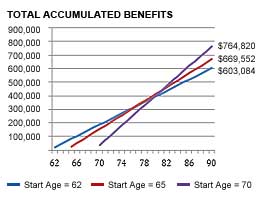
Munnell says it's hard to beat waiting until you're 70 to begin benefits because the monthly payment is 76 percent higher than it would be if you had started to take benefits at 62 and 32 percent higher than it would be if you claimed at age 66.

Betting against death
Betting against deathOn the other hand, some people advocate drawing Social Security benefits at the first opportunity.

Doug Carey, who founded the financial planning software firm WealthTrace, says Social Security doesn't see itself as an oddsmaker, but it does require you to bet on your longevity. He offers this chart as proof. It graphs the break-even point for a person who earned the inflation-adjusted equivalent of $70,000 per year for 35 years. If this person waits until 70 to claim Social Security and lives until at least age 90, he'll accumulate almost $162,000 more in benefits than he would if he had claimed at 62. But there's a possibility of losing the bet and getting nothing.
Retired law professor and Social Security expert Merton Bernstein says the longevity bet odds are bad, so claim early. "You never know when the bell will ring. I subscribe to the Woody Allen principal: 'Take the money and run.'"

A reward for delaying divorce
A reward for delaying divorceIf you're not happy in your marriage after 9 1/2 years, hold off before hiring a divorce attorney.

"Stay married for at least 10 years," says San Francisco-based Bank of America personal banker Raphael Gilbert.
Why? That's what it takes to stake a claim to your ex-spouse's Social Security benefits. If you terminate the marriage after nine years and 11 months, you're out of luck.
If you make it for 10 years, you can collect a Social Security benefit based on up to half of your ex's earnings  
Bigger reward if ex has 'departed'
Bigger reward if ex has 'departed'And we have another dirty little secret for you. If you haven't remarried, chances are your ex-spouse is worth more to you dead than alive -- especially if he or she was a high earner. Once an ex-spouse passes away, you'll be treated just like a widow or widower. If you are at least 60, you'll be able to collect your late-spouse's benefit and allow your own benefit to grow unclaimed until you reach age 70, when you can switch if your own is higher, according to Carol Thomas, who worked for the Social Security Administration for 28 years and answers questions about Social Security at RetirementCommunity.com.

Assuming your ex will dwell on Planet Earth to a ripe old age, the longer your ex-spouse delays claiming Social Security, the better it is for you. So, if you get a chance, encourage your ex to work until age 70. Then, when it's all over, you'll get to claim half of his or her maximum Social Security. Or once you and your ex-spouse reach full retirement age -- usually 66 -- you can claim half your ex's benefit and let your own grow untouched until you're 70, says Thomas. Consider it payback.
  
More flexibility for widows and widowers
More flexibility for widows and widowersSocial Security does a good job of explaining widow and widower benefits, but Dan Keady, director of financial planning for TIAA-CREF Financial Services, says it doesn't clearly spell out a key difference between widow/widower benefits and spousal benefits. A widow/widower can begin benefits based on his or her own earnings record and later switch to survivors benefits or begin with survivors benefits and later switch to benefits based on his or her own record -- even if the surviving spouse is filing before full retirement age. You can't do that with spousal benefits.

In other words, a widow can begin drawing a survivors benefit on her late husband's Social Security when she is as young as 60, but only at a reduced rate. Then she can choose to leave her own Social Security alone, allowing it to grow in value until her full retirement age -- or even age 70. This works for widowers, too.
 
SSDI step 1: Hire help
SSDI Step 1: Hire helpWhen you apply for disability insurance, Social Security doesn't tell you that your first step ought to be hire a lawyer or other expert adviser. Allsup, a private firm that advises people about how to get SSDI, says Social Security doesn't even make it clear that an applicant can have representation from the very beginning of the application process. As a result, lots of people don't get help until they've been initially denied, and that slows down the process unnecessarily, according to Allsup spokeswoman Mary Jung.
Jung also warns SSDI applicants to be accurate and precise on the application. Small mistakes can make a big difference. Minimizing how much exertion was required to perform the person's job is a common mistake that frequently results in denial of a claim.  
35 years is the magic number
35 years is the magic numberThe Social Security website offers an explanation of how your benefits are calculated, but it's a little hard to follow. You can find a simpler explanation at MyRetirementPaycheck.org, a website sponsored by the National Endowment for Financial Education.
Your Social Security payment is figured using a complex calculation based on a 35-year average of your covered wages. Each year's wages are adjusted for inflation before being averaged. If you worked longer than 35 years, the government will use the highest 35 years. If you worked for less than 35 years, they'll average in zeros for the years you are lacking. You don't have to be a math genius to figure out the impact of that -- it drags down your average. If you can avoid zeros by working a couple of years longer, you'll increase your Social Security payment.
 

Read more:http://www.bankrate.com/system/util/print.aspx?p=/finance/retirement/7-social-security-benefits-3.aspx&s=br3&c=retirement&t=story&e=1&v=1#ixzz31cFCsByf
 

How to Get More from Social Security (US News & World Report)

6 ways to get more Social Security
Marriages -- even former ones -- can have significant financial advantages. Here's a look at how having said 'I do' can win you more in retirement benefits.


By U.S. News & World Report

Couples who are currently married, or who have stayed together at least 10 years, tie together their working records -- and the resulting Social Security checks -- as long as they both shall live.

In the case of Social Security payments, the result is often better for the couple than it would have been for a single person. Spouses have Social Security claiming options that single people don't. Here are a few ways couples can boost their Social Security benefits:

1. Utilize spousal payments. Spouses are entitled to a Social Security payout of up to 50% of the higher earner's check (if that amount is higher than benefits based on his or her own working record). Retired couples in which one spouse didn't work or had low earnings have the most to gain from this provision.

However, low-earning spouses must wait until the full retirement age, as the Social Security Administration calls it, to collect the full 50%. Benefits are reduced for spouses who collect before their full retirement age. (For baby boomers born from 1943 to 1954, the full retirement age is 66.)


For example, a low-earning spouse whose full retirement age is 66 would be eligible for only 35% of the higher earner's benefit at age 62. The spousal benefit does not increase above 50% of the higher earner's benefit if claiming is delayed beyond the full retirement age.

2. Claim and suspend. The low-earning spouse cannot receive spouse's benefits until the higher earner files for retirement benefits. Workers who have reached their full retirement age may apply for retirement benefits and then request to have the payment suspended. Claiming and suspending payments allows the lower earner to claim a spousal benefit and the higher earner to continue working and earn delayed retirement credits until age 70.

"This would tend to maximize their lifetime benefits and, more importantly, maximizes the survivor's benefit," says Andrew Biggs, a resident scholar at the American Enterprise Institute and a former deputy commissioner of the Social Security Administration. "You will ensure you will have a higher benefit when you need one, which is when you are a widow later in life."

Social Security checks increase by 7% to 8% for each year of delayed claiming between your full retirement age and age 70. After age 70, there is no additional benefit for waiting to collect your due.

3. Claim twice. Spouses in dual-earner marriages who have reached their full retirement ages can claim Social Security twice: first as spouses, then using their own work records. A person may choose to sign up for only the spousal benefits at full retirement age and continue accruing delayed retirement credits on his or her own Social Security record. That person can then file for benefits based on his or her own work at a later date and receive a higher monthly benefit, thanks to the delayed retirement credits.

For example, a man planning to retire at age 70 could claim a spouse's benefit based on his wife's earnings at age 66 and then claim again based on his own working record when he exits the work force at age 70. High-income couples with relatively equal earnings gain the most using this strategy, according to calculations by the Center for Retirement Research at Boston College.

4. Include family. Social Security recipients who have children under age 16 or who are disabled can secure additional Social Security payments for the child and a spouse caring for the child, even if the spouse is under age 62. Each child is eligible for up to 50% of the retiree's full benefit. However, payments to family members are capped, typically at 150% to 180% of the retiree's benefit payment. If the total benefits due to the retiree's spouse and children are above this limit, their benefits will be reduced. The retiree's payout is not affected.


5. Take advantage of eligibility for ex-spouses. A former spouse may be eligible for benefits if the marriage lasted at least 10 years. The divorced spouse must be age 62 or older and unmarried. The amount of benefits an ex-spouse claims has no effect on the benefits the worker and his or her current spouse can receive.

6. Boost the survivor's benefit. Widows and widowers are entitled to the higher earner's full retirement benefit. A surviving spouse can begin receiving Social Security benefits at age 60, or at age 50 if he or she is disabled. Benefits are reduced by up to 28.5% if claimed before the recipient's full retirement age. The surviving member of a dual-earner couple also can claim a reduced benefit on one working record and then switch to the other.

For example, a woman could take a reduced widow's benefit at age 60, then, when she reaches full retirement age, claim 100% of the retirement benefits based on her own working record. Most survivor benefits are paid to women because wives are generally younger than their husbands and live longer. A spouse can increase the monthly survivor's benefit by 60% by waiting to sign up for Social Security until age 70.

This article was reported by Emily Brandon for U.S. News & World Report.

Published June 1, 2010