What You Will Find Here

My photo
Articles and news of general interest about investing, saving, personal finance, retirement, insurance, saving on taxes, college funding, financial literacy, estate planning, consumer education, long term care, financial services, help for seniors and business owners.

READING LIST

Blog List

Showing posts with label retirement income. Show all posts

Tax-smart investing: What order to take funds out in retirement? (Fidelity)

Withdrawing from retirement accounts: the basics

After working hard to build retirement savings, don't let taxes take a big bite out of them.
Keys takeaways
 Understand the difference between taxable, tax-deferred, and tax-exempt accounts.
 Know which accounts to tap—and when—to maximize tax efficiency.
Chances are you contributed to a 401(k) or IRA as you saved for retirement. Now the time has come to use that money. Withdrawing from retirement savings accounts with an eye toward reducing taxes is important. Taxes can reduce income, and diminish potential future earnings and growth, which affects how long savings may last.
"The important thing to keep in mind is that managing withdrawals with taxes in mind can help boost income in retirement," explains Ken Hevert, senior vice president of retirement at Fidelity.
Let’s start by reviewing the types of investment accounts and then some tax-efficient ways to withdraw from them. Of course, everyone’s situation is unique, so it is important to consult a tax professional.

Three types of investment accounts

A typical retiree may have three types of accounts—taxable, tax-deferred, and tax-exempt. Each has an important, but different, role to play in helping manage tax exposure in retirement.
  • Taxable accounts like bank and brokerage accounts. Any earnings from these accounts, including interest, dividends, and realized capital gains, are generally taxed in the year they’re generated. In the case of capital gains, keep in mind that any increase in value of the accounts’ investments, such as mutual fund shares or an individual stock, isn’t a taxable event in itself. It’s only when an appreciated investment is sold that the gain is realized; i.e., it generates a taxable capital gain or loss. When you own a mutual fund, however, capital gains may be realized by the fund manager and distributed to you—often subjecting you to a tax liability—even if you haven’t sold your fund shares.
  • Tax-deferred accounts like traditional IRAs, 401(k)s, 403(b)s, or SEP IRAs. Most, or all, of contributions to these accounts were likely made "pretax." That means ordinary income tax on those contributions are owed when withdrawals are made in retirement. Any earnings from these accounts are also typically taxed as ordinary income when they’re withdrawn.
  • Tax-exempt accounts like Roth IRAs, Roth 401(k)s, and Roth 403(b)s. Contributions to these accounts are typically made with after-tax money. That means the contributions—and any earnings—are not taxable provided certain conditions are met.1

Manage withdrawals to help reduce taxes

The aim is to manage withdrawals to help reduce taxes, thereby maximizing the ability of remaining investments to grow tax efficiently.
The simplest, most basic withdrawal strategy is to use money from savings and retirement accounts in the order below, with one important caveat. For certain retirement accounts, if you are 70½ or older, required minimum distributions (RMDs) come first. For inherited qualified accounts like a traditional IRA, RMDs may come before age 70½, but the rules are complex, so be sure to check with a tax professional.
1.Taxable accounts (brokerage accounts)
Money in taxable accounts is typically the least tax efficient of the three types. That’s why it usually makes sense to draw down the money in those accounts first, allowing qualified retirement accounts to potentially continue generating tax-deferred or tax-exempt earnings.
Investments may need to be sold when taking a withdrawal. Any growth, or appreciation, of the investment may be subject to capital gains tax. If you’ve held the investment for longer than a year, you’ll generally be taxed at long-term capital gains rates, which currently range from 0% to 20%, depending on your tax bracket (a 3.8% Medicare tax may also apply for high-income earners). Long-term capital gains rates are significantly lower than ordinary income tax rates, which in 2017 range from 10.0% to 39.6%. These are federal taxes; be aware that states may also impose taxes on your investments. (See your federal tax rate.) If you have a loss, you can use it to reduce up to $3,000 of your taxable income, or to offset any realized capital gains. Read Viewpoints "Five steps to help manage taxes on investment gains."
2.Tax-deferred, such as traditional IRAs, 401(k)s, 403(b)s, and SEP IRAs.
You’ll have to pay ordinary income taxes when you withdraw pretax contributions and earnings from a tax-deferred retirement account, but at least these investments have had extra time to grow by taking withdrawals from a taxable account first. You may find yourself in a lower income tax bracket as you get older, so the total tax on your withdrawals could be less. On the other hand, if your withdrawals bump you into a higher tax bracket, you might want to consider taking withdrawals from tax-exempt accounts first. This can be complex, and it may be a good idea to consult a tax professional.
And remember, the IRS generally requires you to begin taking RMDs the year you turn 70½. For employer-sponsored accounts, like a traditional 401(k), you may be eligible to delay taking RMDs if you’re still working at the company and do not own 5% or more of the company or business. You cannot, however, delay starting RMDs for retirement accounts for employers you no longer work for. Read Viewpoints "Smart strategies for required distributions."
3.Tax-exempt, such as Roth IRAs, Roth 401(k)s, and Roth 403(b)s.
Last in line for withdrawals is money in tax-exempt accounts. The longer these savings are untouched, the longer the potential for them to generate tax-free earnings. And withdrawals from these accounts generally won’t be subject to ordinary income tax. They’re totally tax free, as long as certain conditions are met.1
And leaving any Roth accounts untouched for as long as possible may have other significant benefits. For example, money for a large unexpected bill can be withdrawn from a Roth account to pay for a bill without triggering a tax liability (as long as certain conditions are met1). Qualified Roth withdrawals are not factored into adjusted gross income (AGI) because they are not taxable income.  This may help reduce taxes on Social Security and other income because they don't bump up taxable income.
For Roth IRAs, it is important to note that RMDs are not required during the lifetime of the original owner, but for Roth 401(k)s and Roth 403(b)s, the original owners do have to take RMDs. That can be a good reason to consider rolling Roth 401(k)s and 403(b) accounts into Roth IRAs. Roth accounts can be effective estate-planning vehicles for those who wish to leave assets to their heirs. Any heirs who inherit them generally won’t owe federal income taxes on their distributions. On the other hand, Roth accounts are generally not an advantageous vehicle for charitable giving, so those involved in legacy planning may want to avoid the use of Roth accounts to the extent that this money is intended for charity. Be sure to consult an estate planner in either case.

Creating a plan

While the traditional withdrawal hierarchy of taxable, tax-deferred, and tax-exempt assets is a good starting point for many retirees, a person's situation and changing circumstances may mean making adjustments. That’s why it is important to have an overall retirement income plan and regularly revisit it and update it when necessary. 
Suppose, for example, that a person's tax rate will be higher later in retirement than in the first few years. For instance, they move from a low-tax state to a high-tax state. If so, they might want to consider strategies where they pay taxes on their retirement savings earlier in retirement in order to potentially lower taxable income later. One way to do that, depending on a person's situation, would be to shift more of savings to a Roth IRA by converting a portion of a traditional IRA. Learn more about this in Viewpoints “Four tax-efficient strategies in retirement.”
Those who have a significant portion of investments in taxable accounts may be looking for ways to lower a tax bill on the earnings as they gradually draw down the principal to cover retirement living expenses. One consideration that might help is to invest the bond portion of taxable accounts in a diversified mix of municipal bonds, the earnings from which are generally exempt from federal income tax.
Another situation that many retirees experience when they begin withdrawing money from their traditional IRA or 401(k) is that the amount pushes them into a higher tax bracket. In that case, it might make sense to consider withdrawing from a tax-deferred account until taxable income nears the top of a tax bracket, and then tapping a Roth or other tax-exempt account for any additional income.  
Those age 70½ or older might also consider making a qualified charitable distribution (QCD) to satisfy all, a portion of, or even an amount greater than an RMD—up to the IRS limits ($100,000 in 2017). Because the amount donated directly from an IRA to a qualified charity isn’t considered taxable income, this move can help avoid being pushed into a higher tax bracket. It can also be a very useful strategy for those whose high incomes result in phaseouts of itemized deductions. Be sure to consult a tax professional in such cases.
Other factors that could play a significant role in a retirement tax strategy are whether a person intends to continue working, the income tax rate in the state and locality where they plan to retire, and how much of an inheritance they would like to leave for family members or to a charity.

Know your situation

The keys to managing withdrawals from retirement accounts is to know your situation and tax exposure, to understand the basics of smart tax planning, and to consult a trusted professional to get the help you need in designing a tax-efficient retirement income plan.
You work long and hard to build retirement savings; smart tax planning can help keep your savings working for you.


preferred stocks (bARRONS)

TRADER EXTRA

Preferred Picks

With income investors hard-pressed, we went back to the well: that is, to preferred stocks.

September 10, 2016
With income investors hard-pressed, given the artificially low interest-rate environment, we went back to the well: that is, to preferred stocks, last mentioned here on May 14.
The stock market’s dividend yield is just 2.2%, while the 10-year Treasury yields a mere 1.67%. Both have risks, particularly Treasuries, given that the Fed is committed to raising rates, perhaps by December—and possibly sooner, as we note above. A hike would push down bond prices. What it will do to stocks is an unknown danger, too.
Corporate preferreds are an attractive way of securing a higher yield at a lower risk, though their capital gains are likely to be more restrained, too. We returned to Douglas Christopher, an analyst at D.A. Davidson, who gave us five preferred stock picks in May, most with fixed coupons. Although all of them were already above par value then, they’ve risen in price since May.
That high valuation is a problem for investors new to the preferred scene. Fixed-coupon preferred stock prices could drop and be volatile before and after the Fed hikes rates, the analyst notes.
So, this time, he likes adjustable preferreds, most of which are selling significantly below par value (see table, above). Consequently, they could fare better than fixed preferreds if a rate hike materializes, especially if the central bank moves more quickly than markets expect.
In general, the average yield on fixed preferreds is about 5.5%, versus 4.2% for adjustables. The interest rate on adjustables can change, and that’s a risk—but rates should be rising. We’ll note that under the typical underlying terms governing adjustables, it would take a slew of hikes to raise the current coupon rates.
Nevertheless, the dollar payout levels for these five, such as a $1 per year for theGoldman Sachs Group D preferred shares (GS.D), are effectively at their minimums already. So there’s some downside protection. As in the previous batch, these preferreds come mostly from banks whose credit fundamentals and dividends are healthy.
If rates stay flat, you miss out on the better yield of the fixed-coupon preferred. Still, “if you are looking for income and a decent yield, but at a price below par, this is an attractive way to go,” Christopher observes. 

Social Security Basic Facts (bankrate.com)


RETIREMENT

How Social Security works: Nuts and bolts of the benefits program

How Social Security works
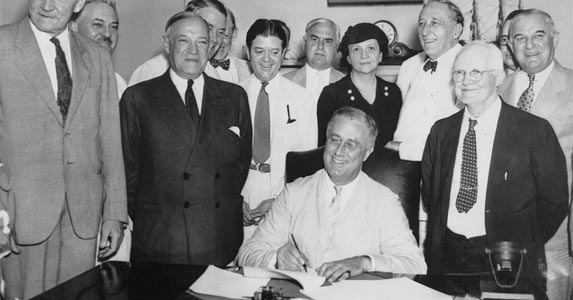
How Social Security works | FPG/Archive Photos/Getty Images

How Social Security works

In 1935, in the midst of the Great Depression, President Franklin D. Roosevelt signed the Social Security Act, creating an insurance program to protect American workers from dire poverty in old age. It has since become a significant thread in the fabric of the national economy. In 2015, more than 59 million Americans -- or about 18.3% of the population -- received close to $870 billion in Social Security benefits.
Over time, amendments to that original act expanded Social Security to include benefits for disabled workers as well as dependents and survivors of the insured. Later, in 1965, Medicare health insurance for older Americans was added to the package.
In spite of these changes, however, the way Social Security works has remained fundamentally consistent throughout its history.


Where does the money for Social Security come from? | Atanas Bezov/E+/Getty Images

Where does the money come from?

The funds tapped for Social Security benefits come from 3 sources. These are:
  1. Payroll taxes;
  2. Interest on 2 trust funds (one for Old-Age and Survivors Insurance, the other for Disability Insurance);
  3. Income taxes from Social Security recipients whose incomes exceed a certain threshold.
The lion's share -- about 85% -- is drawn from payroll taxes.
In any given year, these taxes were originally calculated to cover prevailing needs, but in 1983, Congress raised them in anticipation of a considerable rise in expenditures once the baby boomer generation reached retirement.
Currently, 6.2% of earnings are deducted from an employee's paycheck for Old Age, Survivors and Disability Insurance, up to the maximum taxable income for this purpose of $118,500. Everyone, regardless of income, is assessed an additional 1.45% to cover Medicare insurance. Employers must match the amounts deducted.

How does the government use these payroll taxes? | Swell Media/UpperCut Images/Getty Images

How does the government use these payroll taxes?

The money earmarked for Social Security cannot be used to cover other government expenses until all Social Security expenses have been met, according to the U.S. Government Accountability Office. However, whenever Social Security taxes exceed the amount needed to meet expenditures, the surplus goes into the U.S. Treasury's General Fund, where it is used to reduce the overall federal deficit.
The money is exchanged for special issue, non-tradable Treasury bonds, with the interest from the bonds accruing to the 2 trust funds. The bonds are redeemable whenever Social Security revenues fall short of expenditures.
This practice gives rise to the common perception that the government raids Social Security to fund other programs. But according to the U.S. Treasury, it's in line with the government's unified budget concept, which allows the flow of funds from one program to be applied to another as needed. Without that measure, it's argued that Congress would have to raise taxes, cut payout amounts or borrow from the public.

Does everybody have to pay FICA taxes? | MAVROUDAKIS FOTIS PHOTOGRAPHY/Moment/Getty Images

Does everybody have to pay FICA taxes?

Nearly everyone working in the U.S. must pay Social Security and Medicare taxes, though there are a few exceptions.
These include federal employees hired before 1984, although since 1983 they have had to pay the Medicare portion and are therefore eligible for hospital insurance. Other groups exempted from payroll taxes are railroad employees with more than 10 years of service, employees of those state and local governments who choose not to participate in Social Security, and children under the age of 21 who are paid by a parent for doing household chores. Children over 18 years of age who work in a family business are not exempt from Social Security payroll taxes.
Some wage earners who are eligible for Social Security need to follow special rules in order to be compliant -- for example, the self-employed, military personnel, domestic workers, farm workers and people who work for a church or church-controlled organization that does not pay Social Security taxes.

Is everyone who pays FICA taxes eligible for benefits? | Monty Rakusen/Cultura/Getty Images

Is everyone who pays FICA taxes eligible for benefits?

In general, workers must accumulate a minimum of 40 work credits -- the equivalent of 10 years of paid labor -- to be able to collect retirement benefits. In 2016, you must earn at least $1,260 to get 1 credit, up to a maximum of 4 credits each year.
Qualifying for disability benefits also works on a credit system, but the rules are different depending on the age of a worker when he or she becomes disabled. For example, someone whose disability began before age 24 can qualify for benefits with 6 credits earned over the previous 3 years. Someone over 62, however, must earn 40 credits, at least 20 of them in the 10 years before becoming disabled.

What is COLA and how is it calculated? | HeroImages/Getty Images

What is COLA and how is it calculated?

COLA is an acronym for the Social Security Administration's cost-of-living adjustment. For many years, the payments were static. Then in 1950, Congress approved an increase for the first time, and for the next 25 years, raises required an act of Congress. In 1975, annual adjustments became automatic. They're based on the percentage increase in the Consumer Price Index for Urban Wage Earners and Clerical Workers as computed by the federal Bureau of Labor Statistics.
In 2010, 2011 and again this year, there was no cost-of-living adjustment, since there was no increase in the consumer price index used to determine automatic annual hikes. Monthly Social Security benefits remained stagnant.
Proposals currently under consideration suggest tying Social Security's COLA to other measures of inflation. One idea is to use the Bureau of Labor Statistics' Chained CPI for All Urban Consumers. Proponents say it's a more accurate measure of consumer behavior when prices fluctuate. This would likely result in lower COLAs.
Some proposals advocate using other measures of inflation based on the purchasing patterns of the elderly. Since older people are more vulnerable to fluctuations in health care costs, which go up more rapidly than other consumer goods, this would tend to increase monthly Social Security benefits.

TOP WEBSITES FOR INCOME INVESTORS (KIPLINGERS)

KIPLINGER'S | March 2016

9 Top Free Sites for Income Investors

Five years ago, Kiplinger’s turned to longtime investment writer and in-house income guru Jeff Kosnett to launch a newsletter designed to steer income-starved readers to the best investments for dependable, spendable income. Today, Kiplinger’s Investing for Income continues to attract a growing army of satisfied readers.
How does Jeff uncover opportunities for his subscribers month after month? Of course, he spends a lot of time interviewing money managers and mutual fund masterminds, as well as the men and women who actually run real estate investment trusts (REITs) and master limited partnerships (MLPs). And he mines the Internet, searching for great ideas and studying the raw data to identify broad trends and profitable prospects. We asked Jeff to share with Kiplinger.com readers his favorite free sources for reasoned discussion and hard-to-find financial data. Bookmarking these sites will be a valuable step toward making you a more successful investor.
 

Closed-End Fund Center

Web address: www.cefa.com

Key data: Discounts and premiums to net asset value

Best for: Sorting and screening 629 closed-end funds
The keys to understanding any closed-end fund are data about current and historic discounts and premiums to net asset value, distribution rates, whether and how much the fund borrows (leverage), and total return on net asset value. This site offers all of that and more, plus the tools to sort and screen more than 30 varieties of funds in too many ways to count.
Kosnett Comment: CEFA’s tables show each fund’s distribution yield next to its income yield. The two won’t match, but they should be fairly close. If the income figure is low but the distribution is high, the fund is selling assets or issuing new shares to maintain the illusion of a fat yield. It could be headed for a distribution cut.

Eaton Vance Monthly Market Monitor

Web address: www.eatonvance.com

Key data: The numbers on all aspects of income investments

Best for: Total returns and average duration of bonds
This fund company’s site is loaded with free stuff. The best is the monthly monitor (accessible in the site’s Institutional Investors section): 40-plus pages of charts and tables about all aspects of stocks, bonds, bank-loan funds, commodities, industry sectors and more. All this — including total returns and average duration of more than 20 kinds of bonds — is nicely laid out on single pages.
Kosnett Comment: The page called “fixed income spread analysis” uses simple bar charts to show the current and past yield advantage of various categories, such as junk bonds or preferred stocks, over Treasuries. When the spread is unusually narrow, there’s more risk. When it’s wide, it’s usually a good time to invest.

FRED

Web address: www.stlouisfed.org

Key data: 382,000 statistical series from 82 sources

Best for: Financial data, graphs and charts from the government and everywhere else
If you want to see a trend in, say, inflation, growth, interest rates or stock-market returns for just about any period, you’ll find it here. This takes the place of any almanac, encyclopedia or reference book — and it’s updated daily. FRED is the acronym for Federal Reserve Economic Data and is the brainchild of the Federal Reserve Bank of St. Louis.
Kosnett Comment: You may go weeks or months without using this, and then you’ll refer to it several times in one sitting. It’s comforting to know that someone has gone to the effort of assembling all this info in one place.
FRED

Investing in Bonds

Web address: www.investinginbonds.com

Key data: Real-time market data on bond trading action and prices

Best for: Owners (or potential owners) of individual corporate and municipal bonds and anyone else who wants to see how bonds are priced and what they are yielding at any given time
Kosnett Comment:The Securities Industry and Financial Markets Association (SIFMA), the bond dealers’ trade association, runs the site and has a news feed as well. Some of the commentaries, though, are dated.

Robert W. Baird & Company

Web address: www.rwbaird.com

Key data: Relative yields of municipals and Treasuries

Best for: Analysis of taxable and tax-free bond markets
The managers of Baird Core Plus Bond fund and other excellent no-load income funds publish a combination of basics with just enough financial-market-speak to keep the pros happy with their Capital Markets Perspective. The insights live at Baird’s corporate site (address above) not the Baird Funds' consumer site. Offerings include both tax-free bond and taxable-bond commentaries. A recent subject is the tight supply of new bonds, which keeps prices high and yields low. There is also a colorful market commentary called, ahem, The Bull and Baird Blog.
Kosnett Comment: Baird’s municipal bond letter illustrates such basics as the ratio of tax-free bond yields to Treasury yields and the equivalent yield you need to earn on a taxable investment to net the same after-tax income.

Pimco

Web address: www.pimco.com

Key data: Outlooks and forecasts from the fixed-income behemoth (with $1.43 trillion under management) formerly known as the Pacific Investment Management Company

Best for: Investors who like to see commentaries and explanatory articles that put the market’s gyrations in perspective. For example, an article called “Emerging Markets Trying to Turn the Corner” makes the case for some, but not all, investments in those countries. The Pimco blog about the issues of the day is well-presented and with graphics.
Kosnett Comment: The departure of Bill Gross from Pimco changed this site from his soapbox to more of a team effort.

EMMA

Web address: www.emma.msrb.org

Key data: Muni bond trading details

Best for: Screening the tax-free bond universe for top yields

Electronic Municipal Market Access, from the Municipal Securities Rulemaking Board, shows every municipal bond trade, plus key background information about thousands of issuers. If you own tax-exempts, you can see a price graph for each bond based on months of trades, just as you can chart a stock or a fund. You can also screen the tax-free bond universe in detail. For example, when you search for all AA-rated Arizona water and sewer bonds due between 2024 and 2029, up pop the yields and other particulars.
Kosnett Comment: EMMA is easier to navigate if you know your bond’s CUSIP number.

REIT.com

Web address: www.reit.com

Key data: Historical returns and other performance information for real estate trusts going back to their invention in the 1960s.

Best for: Avid real estate investment trust fans and anyone who wants to see new offerings and news tidbits about the industry and its members. The site is run by the National Association of Real Estate Investment Trusts (NAREIT).
Kosnett Comment: It would be good if NAREIT would link to a resource that provides up to the minute data on the individual REITs’ net asset values and prices to book value. You need a brokerage link to that kind of research.

TCW

Web address: www.tcw.com

Key data: Monthly updates by sector, such as the High Yield and Mortgage Market updates. Find it all under Insights from TCW, a global asset management firm.

Best for: Bond fund investors, especially if you dabble in risky or unusual areas like junk bonds, mortgages and bank loans. There are also excellent forecasts and commentaries from the portfolio managers and analysts.
Kosnett Comment: This is some of the best perspective on individual bond-market segments and what’s driving them up or down.

Protect Your Retirement (Fidelity)

Five ways to protect your retirement income

Five rules of thumb to help protect your savings and income—now and in the future.
 
If you’re nearing or in retirement, it’s important to think about protecting what you've saved and ensuring that your income needs are met now and in the future. Here are five rules of thumb to help manage the risks to your retirement income.

1. Plan for health care costs.

With longer life spans and medical costs that historically have risen faster than general inflation—particularly for long-term care—managing health care costs can be a critical challenge for retirees.
According to Fidelity’s annual retiree health care costs estimate, the average 65-year-old couple retiring in 2014 will need an estimated $220,000 to cover health care costs during their retirement, and that is just using average life expectancy data.1 Many people will live longer and have higher costs. And that cost doesn’t include long term care (LTC) expenses. 
According to the U.S. Department of Health and Human Services, about 70% of those age 65 and older will require some type of LTC services—either at home, in adult day care, in an assisted living facility, or in a traditional nursing home. The average private-pay cost of a nursing home is about $90,000 per year according to MetLife, and exceeds $100,000 in some states. Assisted living facilities average $3,477 per month. Hourly home care agency rates average $46 for a Medicare-certified home health aide and $19 for a licensed non-Medicare-certified home health aide. 
Consider: Purchase long-term-care insurance. The cost is based on age, so the earlier you purchase a policy, the lower the annual premiums, though the longer you’ll potentially be paying for them.
If you are still working and your employer offers a health savings account (HSA), you may want to take advantage of it. An HSA offers a triple-tax advantage: You can save pretax dollars, which can grow and be withdrawn state and federal tax free if used for qualified medical expenses—currently or in retirement.

2. Expect to live longer.

As medical advances continue, it's quite likely that today’s healthy 65-year-olds will live well into their 80s or even 90s. This means there's a real possibility that you may need 30 or more years of retirement income.
An American man who’s reached age 65 in good health has a 50% chance of living 20 more years, to age 85, and a 25% chance of living to 92. For a 65-year-old American woman, those odds rise to a 50% chance of living to age 88 and a one-in-four chance of living to 94. The odds that at least one member of a 65-year-old couple will live to 92 are 50%, and there’s a 25% chance at least one of them will reach age 97.2 And recent data suggest that longevity expectations may continue to increase.
Without some thoughtful planning, you could easily outlive your savings and have to rely solely on Social Security for your income. And with the average Social Security benefit being just over $1,294 a month, it likely won’t cover all your needs.3
Consider: To cover your income needs, particularly your essential expenses, you may want to use some of your retirement savings to purchase an annuity. It will help you create a simple and efficient stream of income payments that are guaranteed for as long as you (or you and your spouse) live.4

3. Be prepared for inflation.

Inflation can eat away at the purchasing power of your money over time. This affects your retirement income by increasing the future costs of goods and services, thereby reducing the purchasing power of your income. Even a relatively low inflation rate can have a significant impact on a retiree’s purchasing power. Our hypothetical example below shows that $50,000 today would be worth only $30,477 in 25 years, even with a relatively low (2%) inflation rate.
Consider: While many fixed income investments and retirement income sources will not keep up with inflation, some sources, such as Social Security, and certain pensions and annuities can help you contend with inflation automatically through annual cost-of-living adjustments or market-related performance. Investing in inflation-fighting securities, such as growth-oriented investments (e.g., individual stocks or stock mutual funds), Treasury Inflation-Protected Securities (TIPS), and commodities, may also make sense.

4. Position investments for growth.

A too-conservative investment strategy can be just as dangerous as a too-aggressive one. It exposes your portfolio to the erosive effects of inflation, limits the long-term upside potential that diversified stock investments can offer, and can diminish how long your money may last. On the other hand, being too aggressive can mean undue risk in down or volatile markets. A strategy that seeks to keep the growth potential for your investments without too much risk may be the answer.
The sample target asset mixes below show some asset allocation strategies that blend stocks, bonds, and short-term investments to achieve different levels of risk and return potential. With retirement likely to span 30 years or so, you’ll want to find a balance between risk and return potential. 
Consider: Create a diversified portfolio that includes a mix of stocks, bonds, and short-term investments, according to your risk tolerance, overall financial situation, and investment time horizon. Doing so may help you seek the growth you need without taking on more risk than you are comfortable with. Diversification and asset allocation do not ensure a profit or guarantee against loss.  Get help creating an appropriate investment strategy with our Planning & Guidance Center.

5. Don't withdraw too much from savings.

Spending your savings too rapidly can also put your retirement plan at risk. For this reason, we believe that retirees should consider using conservative withdrawal rates, particularly for any money needed for essential expenses.
A common rule of thumb is to use a withdrawal rate of 4% to 5%. Why? We examined historical inflation-adjusted asset returns for a hypothetical balanced investment portfolio of 50% stocks, 40% bonds, and 10% cash, to determine how long various withdrawal rates would have lasted. The chart to the right shows what we found: In 90% of historical markets, a 4% rate would have lasted for at least 30 years, while in 50% of the historical markets, a 4% rate would have been sustained for more than 40 years.
Consider: Keep your withdrawals as conservative as you can. Later on, if your expenses drop or your investment portfolio grows, you may be able to raise that rate.

In conclusion

After spending years building your retirement savings, switching to spending that money can be stressful. But it doesn't have to be that way if you take steps leading up to and during retirement to manage these five key risks to your retirement income, as outlined above.