What You Will Find Here

My photo
Articles and news of general interest about investing, saving, personal finance, retirement, insurance, saving on taxes, college funding, financial literacy, estate planning, consumer education, long term care, financial services, help for seniors and business owners.

READING LIST

Blog List

Showing posts with label dividend aristocrats. Show all posts

The new Dividend Aristocrats (from Contrarianoutlook.com)

The 4 Newest Dividend Aristocrats

Brett Owens, Chief Investment Strategist
Updated: April 11, 2016
A couple of weeks ago, I discussed the value of investing in the S&P 500 Dividend Aristocrats, the 50 companies in the index that have hiked their dividends for at least 25 consecutive years.
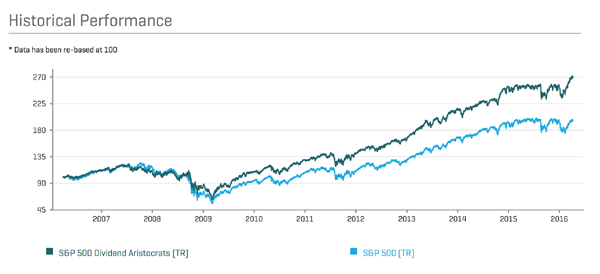
It boils down to performance: in the last decade, this vaunted group has returned an average of 10.3% a year (including dividends), compared to just 6.3% for the S&P 500 as a whole.
Dividend-Historical-Performance
It’s also a list that doesn’t change much. Last year, there was just one adjustment, and it was a removal, after Family Dollar Stores was taken over by Dollar Tree (DLTR).
But in the next 14 months, four companies will punch their tickets to this elite club. Should you invest in them? Here, from worst to first, is my take on the Dividend Aristocrats “class of 2016.”
Linear Technology: Reboot Needed
Analog chipmaker Linear Technology (LLTC) raised its dividend for the 24th straight year in February, making it eligible to enter the pantheon of Dividend Aristocrats in early 2017. The stock currently yields 2.9%.
That’s the good news. The bad? The market for analog chips, which are used in everything from cars to digital cameras, is highly competitive and fragmented. The largest player, Texas Instruments (TXN), controls 18%, compared to just 3% for Linear.
That means the company will have to spend heavily just to hold its own, though it does improve the odds of a takeover by TI or another competitor.
Linear can only hope, because its profits are caught between tough competition and the sluggish economy: in its fiscal 2016 second quarter, earnings per share (EPS) slipped to $0.50 from $0.51 a year earlier, and the company is only expected to report EPS of $1.99 for the full year, down from $2.12 in fiscal 2015.
And if you thought a slow grower like Linear would at least be cheap, you’d be wrong. Its forward P/E ratio clocks in at 22.8, well above Texas Instruments (19.3) and its five-year average (20.5).
Praxair: Sales Vaporized
Praxair Inc. (PX) also marked its 24th straight dividend hike earlier this year. The stock yields 2.7%, and a 25th increase next spring looks like a slam-dunk, thanks to its reasonable 52.9% payout ratio (or the percentage of earnings paid out as dividends).
The company supplies industrial gases, like acetylene (for welding), helium and krypton (used to make windows and semiconductors).
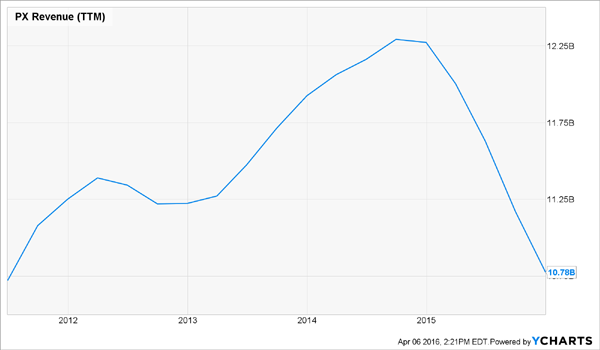
But like Linear, Praxair operates a cyclical business. It also gets 45% of its sales from outside North America, so it’s being hit by the stronger greenback: in the fourth quarter, foreign exchange cut its sales by 10%.
PX-Revenue-Chart
Praxair offset that with cost cuts, which helped it grow adjusted EPS by a penny, to $1.47 from $1.46. But that only goes so far: what it really needs is a manufacturing rebound—particularly in China and Brazil—and I don’t see that happening anytime soon.
General Dynamics: The Pentagon’s BFF
General Dynamics (GD) became a Dividend Aristocrat with gusto in early March, marking its 25th year of dividend hikes by announcing a 10% increase, payable in May.
Hikes like that are par for the course for the defense giant, which has raised its payout by 230% since 2006. Keeping its membership in the Dividend Aristocrat club will be a cinch: its payout ratio sits at just 29%.
The knock on General Dynamics is its reliance on the US government (57% of 2015 revenue) to buy its tanks, ships and computer systems. That’s a risk, to be sure, but with terrorist threats on the rise, I don’t see that spending slowing down anytime soon.
Wall Street is also bullish: the average analyst estimate sees EPS rising 3.2% this year and 7.4% in 2017.
Even better, these overwrought worries have dropped the stock’s forward P/E ratio to 13.8, below competitors likeRaytheon (RTN), at 18.0, Rockwell Collins (COL), at 17.3, and Lockheed Martin (LMT), at 18.6.
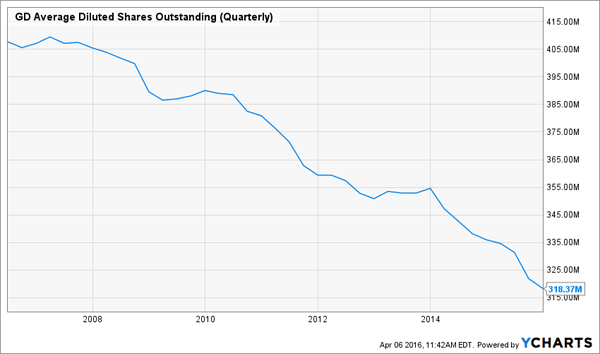
That hasn’t been lost on General Dynamics’ board, which authorized a 10-million-share buyback in December. That’s a big plus, because fewer shares translate directly into higher EPS and share prices.
GD-Shares-Outstanding
The Valedictorian: Roper Technologies
Roper Technologies Inc. (ROP), my top pick among these four, has the one ingredient General Dynamics lacks: diversification.
Roper is a Florida-based industrial firm that increased its payout for the 24th consecutive time in January. Look for it to hit the magic number in January 2017.
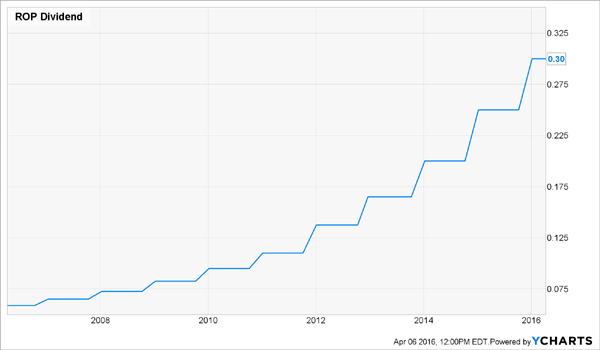
It’s a good thing companies don’t need a high dividend yield to become Dividend Aristocrats, or Roper’s 0.68% would surely disqualify it. But that low yield masks an incredible growth story: in the past decade, the payout has jumped 410%.
ROP-Dividend
Roper has four main segments: medical and scientific imaging, radio-frequency ID systems (mainly used for toll roads, security cards and remote monitoring), industrial technology, and energy systems and controls.
The stock’s down 6.5% this year on worries weak oil prices will keep weighing on energy firms’ spending.
But energy is Roper’s smallest business, chipping in just 16% of its total revenue in 2015. When you strip out energy and industrial products—the two most volatile divisions—you’ll see that the others (representing 63% of total revenue between them) are going gangbusters, notching a combined 14.6% sales increase in Q4, and an 18.8% rise in operating profits.
Meantime, Roper trades at 24 times its forecast earnings over the next 12 months and just 20 times free cash flow. That’s a reasonable price in light of its growth potential, both organically and through acquisitions.

Best Big Company Dividend Stocks (investor place)

America’s 25 Best-Yielding Large-Cap Dividend Stocks

by James Brumley | December 29, 2015 2:03 pm
Looking for some income in your portfolio? Even growth-oriented investors can appreciate dividend stocks and the payouts they provide, even if that cash is ultimately earmarked for the purchase of growth stocks. And as for income lovers: With bonds still paying next to nothing despite the Federal Reserve’s plans to start ratcheting up interest rates, dividend stocks are the only viable way to drive cash flow at a level that at least keeps pace with inflation.
[1]With that as the backdrop — and with a new calendar year being the perfect reason to reconfigure a portfolio — a closer look at the market’s biggest and best dividend stocks is merited.
It’s not a look that should be taken lazily, mind you. Sometimes a dividend yield is high simply because a stock has fallen in anticipation that its dividend will soon be cut. On the other hand, sometimes a yield is strong because the market proverbially threw the baby out with the bathwater. Even the names that have fallen due to fears of a reduced dividend, however, can sometimes make for worthy speculations.
The situation doesn’t become clear until a particular company is scrutinized.
  • The 6 Best Dividend Stocks to Buy in 2016[2]
Whatever the case, to help investors get their search for income started, here’s a closer look at the 25 large caps with the biggest payouts. The list was assembled without bias or assumption; it’s just a list of the market’s major dividend stocks, starting with the smallest payout and working its way to the biggest.
#25: Duke Energy (DUK[3]), 4.59% Dividend Yield: Duke Energy may be the first utility name on this list of dividend stocks for income investors to consider owning in 2016, but it won’t be the last. Utilities are among the most stable and stereotypical of dividend stocks, serving as a toll booth that all consumers are required to cross once per month … forever. That’s how Duke can afford its current 4.59% dividend yield. That said, a potentially brutal winter could spur an especially solid first quarter for Duke Energy and its peers going forward.
#24: Philip Morris International (PM[4]), 4.61% Dividend Yield: The public certainly loves to publicly hate Big Tobacco. Yet, investors certainly love to own these names too. Reynolds American, Inc. (RAI[5]) shares were up 45% in 2015, while Altria Group Inc (MO[6]) shares gained 20%. The company that income seekers want to take a puff on within the tobacco arena, however, is Philip Morris International. PM currently sports a yield of 4.61%, and despite anti-smoking efforts that seem to be worldwide, that dividend is rather well-protected, and the company has made a concerted effort to remain shareholder-friendly.
#23: Southern Co (SO[7]), 4.61% Dividend Yield: As promised, Duke Energy isn’t the only utility name to earn a spot on this list of compelling dividend stocks. Southern Company has continued to ride a rising tide of earnings growth, and has passed a big chunk of that income along to investors. That’s not going to change anytime soon. Indeed, Southern Co is wading a little further into wind and solar now[8], diversifying its production capacity, and therefore giving it some fiscal flexibility (even though wind and solar are not consistently profitable ventures).
#22: International Paper (IP[9]), 4.62% Dividend Yield: Once again, paper manufacturer International Paper is underappreciated and underestimated. Granted, it’s not a sexy business, and the dynamics of the paper market can ebb and flow enormously in just short while. It’s always an industry that lands on its feet, though, as paper usage is almost like utility usage … we can’t seem to get around it.
#21: Chevron Corporation (CVX[10]), 4.74% Dividend Yield: In light of what’s going on with the oil market, it’s tough to own a name like Chevron Corporation, even if the current yield is well above 4%. CVX seems to have a hand in every aspect of the energy market, none of which have been compelling for months. Worse still, with crude stockpiles in the U.S. rising back to unwieldy levels while OPEC remains adamant about sustaining its output[11], there’s no end in sight to the oil glut that’s making life miserable for these companies. The herd is starting to thin out, however, and it may well be a sign that things will finally start to improve for the energy market in 2016. When that happens, the biggest and the strongest survivors — like Chevron — will be well-positioned to ride the recovery wave. It just takes a little faith that nothing lasts forever.
Next Page – #20-#11[12]
#20: Verizon (VZ[13]), 4.83% Dividend Yield: Verizon usually is classified as a consumer service stock, but truth be told, it’s as much of a utility stock and a commodity as it is a service play. It’s that hybrid nature, however, that makes a telecom name like Verizon and its massive dividend so attractive. VZ may not be able to take a lot of new market share, but it’s also not giving any real share up to other players in this space. And to its credit, Verizon is also trying new things like a streaming television service[14] as a way to boost its growth opportunities.
#19: Welltower (HCN[15]), 4.89% Dividend Yield: You may know it better as Health Care REIT; the name was changed in September. The name is irrelevant, however. What matters is that this assisted-living facilities and long-term and post-acute-care facilities REIT owns 1,400 different properties, and uses them to support a dividend yield nearing 5%.
#18: Entergy (ETR[16]), 4.94% Dividend Yield: Another utility stock? Yep. Just think of it as a testament to the importance and reliability of the sector to income investors. The dividend yield for ETR is a healthy 4.94%, and like most other utility names, Entergy has a decent history of rising payouts. One key distinction with Entergy — it’s also an electricity wholesale producer.
#17: Host Hotels and Resorts Inc. (HST[17]), 5.07% Dividend Yield: Like Welltower, Host Hotels and Resorts is a REIT. Unlike Welltower, though (and as its name clearly suggests), Host Hotels and Resorts operates hotels, and directs the bulk of that income back to investors to support its current dividend yield of 5.07%. REITs must pay out at least 90% of their income to shareholders in the form of dividend to legally maintain its tax-advantaged status, and for that reason, it and Welltower aren’t the only REITs to appear in this list of dividend stocks.
#16: Ventas (VTR[18]), 5.23% Dividend Yield: Ventas is yet another REIT with a strong payout. VTR is more like Welltower than Host Hotels and Resorts in that it operates healthcare facilities. Specifically, its portfolio consists of a combination of senior housing communities, medical office buildings, nursing facilities, hospitals and more … a total of 1,300 properties in all (and it’s still not the last REIT on this list).
#15: National-Oilwell Varco (NOV[19]), 5.39% Dividend Yield: Like most other energy-related stocks, National-Oilwell Varco was a miserable performer in 2015, losing nearly half of its value. Unlike many of its sector peers and rivals, though, National-Oilwell Varco has remained profitable, and has pretty fiercely defended what has become a dividend yield of 5.39% thanks to the big pullback. NOV has remained profitable mostly because it leases equipment to explorers and drillers, and hasn’t been affected quite as harshly as other energy companies have.
#14: AT&T (T[20]), 5.52% Dividend Yield: Surely you didn’t think Verizon would appear on a list of dividend stocks that didn’t include AT&T, did you? The only difference between the two is, Verizon is paying 4.83%, while AT&T presently boasts a dividend yield of 5.52%. Don’t jump to the conclusion that T is a better way to play than VZ, however. Verizon arguably has more room for dividend growth, as AT&T already spends most of its cash flow on shareholders and has added new debt in recent years. And while its pairing with DirecTV has brought a bevy of new potential customers into the fold, it wasn’t a cheap acquisition[21] given its risk. How many more of those can AT&T afford if that’s the only growth plan it can come up with?
#13: Spectra Energy Partners (SEP[22]), 5.68% Distribution Yield: Incredibly enough, Spectra Energy Partners is the first MLP to show up on this list of strong dividend stocks to mull for 2016. It won’t be the last, however. MLPs — short for master limited partnerships — are tax-advantaged, publicly traded entities that facilitate the pass-through of income to investors the way conventional partnerships do. While theoretically any revenue-bearing operation could become an MLP, it’s a legal framework that lends itself to the nature of oil and gas pipelines and storage systems. It has been a troubled segment of the energy market of late, but the pullback from SEP has pumped up its yield to a healthy 5.68%. The question is: Can that payout continue?
#12: Las Vegas Sands (LVS[23]), 5.89% Dividend Yield: That’s not a misprint — casino owner and operator Las Vegas Sands is not only boasting a dividend yield of 5.89%, it has remained profitable against an industry headwind in Macau. Better yet, the company already announced an increase of more than 10% in 2016’s dividend payout, so the trailing yield figure understates what shareholders can expect to pocket in 2016.
#11: HCP, Inc. (HCP[24]), 5.91% Dividend Yield: The last REIT to appear on this list of dividend stocks worthy of consideration is the uncreatively named HCP. Like its aforementioned healthcare REIT peers, HCP deals in businesses such as senior living developments and medical offices, which are extremely stable sources of income that offer a great deal of growth potential as more baby boomers reach retirement age.

#10: Enterprise Products Partners, L.P. (EPD[26]), 6.17% Distribution Yield: Enterprise Products Partners is another MLP to — thanks to persistent weakness from the stock all year long — earn a spot on a list of dividend stocks to consider. EPD is the natural gas liquids business side of Enterprise Products Company, and operates more than 50,000 miles of pipelines for natural gas, NGL, crude oil and other products. Like Spectra Energy Partners, Enterprise Products Partners has technically remained profitable over the past few quarters, even while the industry has struggled. Between that and the fact that EPD was one of the first middlemen to secure an overseas supply deal[27] when the U.S. recently lifted the ban on the export of crude oil, its yield of 6.17% is surprisingly well-protected.
#9: Spectra Energy Corp. (SE[28]), 6.24% Dividend Yield: If the name rings a bell, it may be because its business counterpart, Spectra Energy Partners, was No. 13 on our list of strong dividend stocks. More important, Spectra Energy Corp. sports a yield of 6.24%. Just bear in mind the fate of one is largely tied to the fate of the other name as part of the MLP structure.
#8: ConocoPhillips (COP[29]), 6.27% Dividend Yield: Like Chevron Corporation, ConocoPhillips — the country’s third-largest integrated energy giant — is diversified across most facets of crude oil and natural gas. And unfortunately, COP has dropped as the fortunes of both commodities have dropped. On the other hand, for the same reason an investor might be willing to roll the dice on COP (anticipating at least some sort of stability for oil prices in 2016), COP may just be a worthy bet. The dividend payout of 6.27% in the meantime isn’t too shabby either.
#7: Blackstone (BX[30]), 6.45% Distribution Yield: Blackstone is one of the world’s premier global investment firms, investing in everything from private and public businesses to real estate, and offering products such as hedge and closed-end funds. It boasts $92 billion in assets under management. Just think of it as a conservative, actively managed ETF that dishes out income at a rate of 6.45%.
#6: CenturyLink (CTL[31]), 8.36% Dividend Yield: Despite being the third-biggest telecom name in the country in terms of total lines served, most investors have never heard of CenturyLink. That’s too bad, because its dividend yield of 8.36% is quite attractive. Granted, the quarterly payout took a hit in 2013, and the company has yet to boost it in the meantime. The top and bottom lines are starting to edge upward again, however, so it’s possible a shareholder-friendly CenturyLink could start to increase its dividend in the foreseeable future.
#5: Energy Transfer Equity LP (ETE[32]), 8.46% Distribution Yield: Like the Spectra duo, Energy Transfer Equity LP is another MLP that has struggled of late thanks to slumping oil and gas prices. As has been the case with so many other pipeline plays, though, the 59% setback that ETE suffered in the second half of 2015 may have been overdone, meaning the market might not let the current yield of 8.46% linger much longer. (Note that Energy Transfer Equity is slated to acquire another pipeline name appearing later on this list.)
#4: KKR & Co. L.P. (KKR[33]), 8.86% Distribution Yield: Like Blackstone, KKR is a major private equity firm that has made its coin on leveraged buyouts, boasting some $400 billion in PE deals over its lifetime. Its portfolio includes companies such as Alliant Insurance Services, GoDaddy Inc (GDDY[34]) and Toys “R” Us., but it also manages real estate holdings and manages hedge funds as well. More important to income investors, it’s presently paying out 8.86% of its value as dividends.
#3: Williams Companies (WMB[35]), 10.32% Dividend Yield: Yes, another pipeline play, and yes, another MLP … sort of. Williams Companies is majority owner of Williams Partners LP (WPZ[36]), though WMB isn’t technically an MLP in itself. The structure is irrelevant, though. What matters is that it offers a dividend yield of 10.32% … at least for the time being. Energy Transfer Equity LP will complete a merger with Williams Companies sometime in 2016, which will have an impact on …
#2: Williams Partners LP (WPZ[36]), 12.54% Distribution Yield: Williams Partners LP is 60% owned by the aforementioned Williams Companies, so it’s no surprise the two entities are found side-by-side on this list of dividend stocks. They aren’t perfect twins, however, and the other 40% of WPZ shares can and do move independently. That’s how Williams Partners sports a notably better yield of 12.54%.
#1: Energy Transfer Partners LP (ETP[37]), 12.63% Distribution Yield: Finally, pipeline MLP Energy Transfer Partners LP offers a payout of 12.63% of the stock’s price. Yes, this is the companion stock to (and is owned by, technically) Energy Transfer Equity LP, which was found in the No. 5 slot of our list of fat dividend stocks. It’s also one of the most polarizing names among income investors because the outcome of the union of Energy Transfer Equity and Williams Companies isn’t clear, but will certainly be felt by ETP owners one way or another. Whatever the case, if you can stomach the uncertainty and if you believe that consolidation can sustain strong payouts in the struggling energy industry, ETP may well be worth a look.
As of this writing, James Brumley did not hold a position in any of the aforementioned securities.

More From InvestorPlace

  • The 7 Best Monthly Dividend Stocks for 2016[38]
  • The 10 Best Index Funds for 2016 … And Beyond![39]
  • The 10 Best Vanguard Funds to Buy for 2016[40]
Endnotes:
  1. [Image]: http://investorplace.com/hot-topics/best-of-2015-16/
  2. The 6 Best Dividend Stocks to Buy in 2016: http://investorplace.com/2015/12/the-6-best-dividend-stocks-to-buy-in-2016/
  3. DUK: //investorplace.com/stock-quotes/duk-stock-quote/
  4. PM: //investorplace.com/stock-quotes/pm-stock-quote/
  5. RAI: //investorplace.com/stock-quotes/rai-stock-quote/
  6. MO: //investorplace.com/stock-quotes/mo-stock-quote/
  7. SO: //investorplace.com/stock-quotes/so-stock-quote/
  8. wading a little further into wind and solar now: http://www.southerncompany.com/news/2015-11-30-spc-roserock.cshtml
  9. IP: //investorplace.com/stock-quotes/ip-stock-quote/
  10. CVX: //investorplace.com/stock-quotes/cvx-stock-quote/
  11. OPEC remains adamant about sustaining its output: http://www.wsj.com/articles/opec-sees-fall-in-non-opec-oil-supplies-as-low-prices-hit-its-rivals-1449745603
  12. Next Page – #20-#11: http://investorplace.com/2015/12/2016-americas-25-high-yielding-large-cap-dividend-stocks/2/
  13. VZ: //investorplace.com/stock-quotes/vz-stock-quote/
  14. streaming television service: http://www.verizon.com/home/livetv?incid=myvzhero2_MYVZ_TV_HERO_CTA_3_get_the_free_app
  15. HCN: //investorplace.com/stock-quotes/hcn-stock-quote/
  16. ETR: //investorplace.com/stock-quotes/etr-stock-quote/
  17. HST: //investorplace.com/stock-quotes/hst-stock-quote/
  18. VTR: //investorplace.com/stock-quotes/vtr-stock-quote/
  19. NOV: //investorplace.com/stock-quotes/nov-stock-quote/
  20. T: //investorplace.com/stock-quotes/t-stock-quote/
  21. it wasn’t a cheap acquisition: http://time.com/104428/att-directv-merger/
  22. SEP: //investorplace.com/stock-quotes/sep-stock-quote/
  23. LVS: //investorplace.com/stock-quotes/lvs-stock-quote/
  24. HCP: //investorplace.com/stock-quotes/hcp-stock-quote/
  25. Next Page – #10-#1: http://investorplace.com/2015/12/2016-americas-25-high-yielding-large-cap-dividend-stocks/3/
  26. EPD: //investorplace.com/stock-quotes/epd-stock-quote/
  27. secure an overseas supply deal: http://www.wsj.com/articles/u-s-to-export-crude-oil-cargo-in-early-january-1450894791
  28. SE: //investorplace.com/stock-quotes/se-stock-quote/
  29. COP: //investorplace.com/stock-quotes/cop-stock-quote/
  30. BX: //investorplace.com/stock-quotes/bx-stock-quote/
  31. CTL: //investorplace.com/stock-quotes/ctl-stock-quote/
  32. ETE: //investorplace.com/stock-quotes/ete-stock-quote/
  33. KKR: //investorplace.com/stock-quotes/kkr-stock-quote/
  34. GDDY: //investorplace.com/stock-quotes/gddy-stock-quote/
  35. WMB: //investorplace.com/stock-quotes/wmb-stock-quote/
  36. WPZ: //investorplace.com/stock-quotes/wpz-stock-quote/
  37. ETP: //investorplace.com/stock-quotes/etp-stock-quote/
  38. The 7 Best Monthly Dividend Stocks for 2016: http://investorplace.com/2015/12/7-best-monthly-dividend-stocks-2016/
  39. The 10 Best Index Funds for 2016 … And Beyond!: http://investorplace.com/2015/12/best-index-funds-investing/
  40. The 10 Best Vanguard Funds to Buy for 2016: http://investorplace.com/2015/12/best-vanguard-funds-2016/
Source URL: http://investorplace.com/2015/12/2016-americas-25-high-yielding-large-cap-dividend-stocks/
Short URL: http://bit.ly/1UfjGKB

Finding High Dividend Stocks that are Not in Distress - Cash Flow Yield (Marketwatch)

Opinion: 10 dividend stocks for safe income as interest rates rise

Published: Dec 20, 2015 11:19 a.m. ET

Verizon, Altria and eight other companies probably will be less hurt by the Fed’s policy change

Bloomberg
Verizon Communications’ stock has a yield close to 5% and plenty of ‘headroom’ to raise its quarterly payout.
As junk-bond investors have suffered acute pain heading into the Federal Reserve’s decision to increase interest rates Wednesday, dividend-stock investors can take solace because they will probably be affected to a much lesser degree.
Large-cap stocks with solid long-term dividend track records tend to outperform the broader market, no matter the interest-rate environment.
When interest rates rise, bond prices fall so that existing bond yields will match the yields of newly issued bonds (with similar ratings) with higher interest rates. The higher the yield, the more the bond will decline in value when rates rise, and increase in value when rates drop.
But that doesn’t necessarily hold true for stocks with attractive dividend yields, since companies may still be growing their businesses or have plenty of cash flow to support increasing dividends. It’s also quite likely that the Fed will take a slow-and-steady pace in lifting interest rates. The federal funds rate was been locked in a range of zero to 0.25% from late 2008 until today, when the target range was lifted to 0.25% to 0.50%. Chances are, interest rates probably will still be near record lows a year from now.
Then again, if the U.S. economy keeps growing at its current modest pace (the median estimate among FOMC members and regional Federal Reserve Bank presidents is 2.1% for 2015), the Fed projects the federal funds rate may range from 2.9% to 3.9% in 2018. The central bank clearly wants to regain effective use of its main policy tool, so that lowering rates when the next recession eventually hits, can be effective. This means a likely long-term upswing in interest rates.
If you are selecting dividend stocks, you will want to be careful to consider how likely a company may be to cut its dividend, which can be an absolute killer for the share price. The market often “prices in” anticipated dividend cuts, as we have seen this year in the energy and materials sectors. The brutal environment for commodities has affected companies in other sectors, such as construction-equipment maker Caterpillar Inc. CAT, +0.32% The stock is down 27% this year, pushing its dividend yield up to 4.61%. No one can predict whether Caterpillar will cut its dividend, especially since the company bought back $1.5 billion in common shares during the third quarter, even though it is in the midst of a major restructuring. 
One way to gauge a company’s ability to raise dividends, or at least not cut them, is to divide its free cash flow per share by the share price to come up with a free cash flow yield. And that can be compared with the dividend yield. A company’s free cash flow is its remaining cash flow after capital expenditures.
To present a useful list of dividend stocks with dividend yields that appear safe, we started with the S&P 500, and then removed stocks with negative returns of 15% or more this year. After all, investors have little confidence in them.
We then pared the list to companies that have paid dividends for at least five years, while removing any that have cut regular dividends at any time over the past five years, according to FactSet.
Here are the 10 remaining S&P 500 stocks with the highest yields, as well as “headroom” to raise or maintain dividends:
CompanyTickerIndustryFree cash flow yield - past 12 monthsDividend yield‘Headroom’
HCP Inc.HCP,-2.58%Real Estate Investment Trusts8.72%6.23%2.48%
Mattel Inc.MAT,-2.46%Recreational Products5.99%5.61%0.38%
AT&T Inc.T, -1.26%Telecommunications7.01%5.56%1.45%
Welltower Inc.HCN,-1.15%Real Estate Investment Trusts6.62%5.11%1.52%
Verizon Communications Inc.VZ, -1.17%Telecommunications10.12%4.96%5.16%
Philip Morris International Inc.PM,-2.42%Tobacco4.68%4.64%0.03%
Realty Income Corp.O, +0.16%Real Estate Investment Trusts5.40%4.58%0.82%
People’s United Financial Inc.PBCT,-2.21%  Savings Banks4.89%4.11%0.78%
Kimco Realty Corp.KIM,-1.64%Real Estate Investment Trusts6.15%3.94%2.20%
Altria Group Inc.MO,-2.22%Tobacco4.88%3.94%0.94%
Source: FactSet
For real estate investment trusts, we used funds from operations instead of free cash flow, because FFO is generally considered to be the best measure of a REIT’s dividend-paying ability.
Since REITs are primarily income plays, one might expect their prices to drop in a way similar to bonds when interest rates rise. But the REITs listed here all invest in income-producing properties, with the goal of increasing FFO and dividends. If their strategies are executed well, these may be excellent plays, as long as your objective is income and you can bear volatility while staying committed for the long term. Besides, if former Federal Reserve Chairman Ben Bernanke is correct, we’re likely to remain in a relatively low interest-rate environment for years to come.
Verizon Communications Inc. VZ, -1.17%  is an interesting dividend stock, as it has the highest “headroom” on the list, based on the past 12 months’ free cash flow.

Dividend Aristocrats Yielding over 4 Percent (Marketwatch)

13 ‘Dividend Aristocrat’ stocks with yields over 4%

gPublished: Nov 25, 2015 3:42 p.m. ET
by Philip van Doorn; 415-439-6400; AskNewswires@dowjones.com40

These are investments to hold for the long run, regardless of rising official interest rates
AT&T is among the highest-yielding stocks included in the S&P High Yield Dividend Aristocrats Index.

The S&P 500 Dividend Aristocrats Index has greatly outperformed the broader S&P 500 Index over the past 10 years, and includes many quality companies that raise their payouts year after year. But S&P Dow Jones Indices has a High-Yield Dividend Aristocrats Index that can help you find even higher-yielding stocks.
Most financial-media news is geared toward current events that can affect stock prices over the short term. But many investors are much more concerned with longer-term strategies for growth or income.
For long-term growth investors — that is, those who truly wish to invest in companies for many years — we recently discussed an approach that considers some key performance numbers, but more importantly, factors in investors’ own belief of whether a company’s products or services will remain popular for decades.
But some investors are primarily concerned with income, which has shrunk as interest rates have fallen since 2008. The Federal Reserve is expected to begin raising the short-term federal funds rate soon, from a range of zero to 0.25%.
If interest rates start to rise, market prices of bonds and preferred stocks will fall. That is natural and expected by most income-seeking investors. It can be especially difficult for investors holding shares in bond mutual funds or other income funds because of their fluctuating share prices, which are based on the market values of the securities held by the funds. There’s no guarantee that your losses in a bond fund will ever be recovered.
But if you hold your own bonds or preferred stocks, you already know how much of a premium, if any, you paid when making the purchase, and therefore know how much you will lose (or gain, if you bought at a discount) when a bond matures or if a preferred stock is called. Holding your own paper can be wonderful because you not only keep all the interest or dividends being paid, you also don’t have to worry about market-price fluctuations.
Of course, this assumes your investment objective really is income, and that you are disciplined enough to keep holding the paper.
But at a time when interest rates around the world are so low, and when issuers are borrowing as much as possible to lock in low rates, the risk of a bond default appears to be growing, as Howard Gold described in great detail Wednesday.
Dividend Aristocrats
The S&P 500 Dividend Aristocrats Index SPDAUDP, +0.13% includes 52 companies among the S&P 500 SPX, +0.06% that have raised dividends each year for at least 25 years, according to S&P Dow Jones Indices.
“The index treats each constituent as a distinct investment opportunity without regard to its size by equally weighting each company,” according to S&P Dow Jones Indices.
Here’s how the Dividend Aristocrats Index has performed against the S&P 500 over the past 10 years:
FactSet
That’s big-time outperformance. Investors looking for long-term growth, who buy into the idea that a long track record of raising dividends implies strong overall performance, can “play” the Dividend Aristocrats via the ProShares S&P 500 Dividend Aristocrats ETF NOBL, +0.18% (Disclosure: I hold shares of NOBL.)
Here are the 10 highest-yielding S&P 500 Dividend Aristocrats:
CompanyTickerIndustryDividend yield
HCP Inc.HCP, +0.82%Real Estate Investment Trusts6.76%
AT&T Inc.T, +0.36%Major Telecommunications5.65%
Chevron Corp.CVX, -0.55%Integrated Oil4.70%
Consolidated Edison Inc.ED, +0.29%Electric Utilities4.16%
Emerson Electric Co.EMR, +0.10%Electrical Products3.90%
AbbVie Inc.ABBV, -0.48%Major Pharmaceuticals3.78%
Nucor Corp.NUE, +0.26%Steel3.68%
Exxon Mobil Corp.XOM, -0.02%Integrated Oil3.65%
Procter & Gamble Co.PG, -0.26%Household/Personal Care3.53%
Wal-Mart Stores Inc.WMT, -0.58%Discount Stores3.27%
Sources: S&P Dow Jones Indices, FactSet
A stock doesn’t need to have a very high yield to be included in the S&P 500 Dividend Aristocrats. The main idea is consistent dividend increases. Only four of those stocks have yields above 4%.
High-Yield Dividend Aristocrats
The S&P High-Yield Dividend Aristocrats SPHYDA, +0.24%  has more aggressive criteria, since it starts with the S&P 1500 Composite Index, which is made up of the S&P 500, the S&P Mid-Cap 400 Index MID, +0.32%  and the S&P 600 Small-Cap Index SML, +0.32% It includes 100 companies that have raised their dividends each year for at least 20 years (rather than 25 years for the S&P 500 Dividend Aristocrats).
The S&P High-Yield Dividend Aristocrats Index has underperformed the S&P 500 Dividend Aristocrats Index by quite a bit over the past 10 years:
FactSet
But the idea here is to produce a list of higher-yielding stocks of companies that love to raise dividends year after year.
Here are the 15 S&P High-Yield Dividend Aristocrats with the highest current yields:
CompanyTickerIndustryDividend yield
HCP Inc.HCP,+0.82%Real Estate Investment Trusts6.76%
AT&T Inc.T, +0.36%Major Telecommunications5.65%
Mercury General Corp.MCY,+0.76%Property/Casualty Insurance4.92%
Realty Income Corp.O, +1.24%Real Estate investment Trusts4.72%
National Retail Properties Inc.NNN,+0.99%Real Estate Investment Trusts4.70%
Chevron Corp.CVX, -0.55%Integrated Oil4.70%
Questar Corp.STR, +0.10%Gas Distributors4.57%
Caterpillar Inc.CAT, -0.38%Trucks/Construction/Farm Machinery4.44%
Consolidated Edison Inc.ED, +0.29%Electric Utilities4.16%
MDU Resources Group Inc.MDU,-0.62%Gas Distributors4.15%
Old Republic International Corp.ORI, -0.21%Property/Casualty Insurance4.05%
People’s United Financial Inc.PBCT,+0.12%Savings Banks4.05%
Black Hills Corp.BKH,+0.16%Electric Utilities4.02%
Vectren Corp.VVC, -0.07%Gas Distributors3.92%
Emerson Electric Corp.EMR,+0.10%Electrical Products3.90%
Sources: S&P Dow Jones Indices, FactSet
There’s plenty of overlap between the two lists, but now we have a list of 15 stocks, 13 of which have yields above 4%.
If you look at the industries of those companies, you may have some concern for Chevron Corp. CVX, -0.55%  and the three gas distributors because of the big decline in oil and natural gas prices over the past year and a half. Then again, the companies have ridden out several price disruptions over the past 20 years, and they have continued to raise dividends.
Caterpillar is another company you might be concerned about, since the decline in construction activity in China, along with the resulting drop in demand for copper and other commodities, have been very hard on the company.
Digging further
We cannot predict if any of the companies will cut their dividends, and their inclusion among the High-Yield Dividend Aristocrats speaks for itself.
But what we can do is compare the current yields with the companies’ free cash flow yields to consider how easily they’re covering dividends and the likelihood of further increases.
A company’s free cash flow is its remaining cash flow after capital expenditures. For real estate investment trusts, we are using funds from operations instead, because this is the generally accepted measurement of a REIT’s cash flow available for dividends.
We can then compare the companies’ free cash flow yields for the past 12 months to their current yields, to see if there is any “headroom.”
Here are free cash flow yields calculated by FactSet (except for the REITs, as described above) for the 15 highest-yielding High-Yield Dividend Aristocrats:
CompanyTickerFree cash flow yield - past 12 monthsDividend yield‘Headroom’
HCP Inc.HCP,+0.82%9.46%6.76%2.69%
AT&T Inc.T, +0.36%7.13%5.65%1.48%
Mercury General Corp.MCY,+0.76%6.26%4.92%1.34%
Realty Income Corp.O, +1.24%5.57%4.72%0.85%
National Retail Properties Inc.NNN,+0.99%6.03%4.70%1.32%
Chevron Corp.CVX,-0.55%-6.25%4.70%-10.95%
Questar Corp.STR,+0.10%2.94%4.57%-1.63%
Caterpillar Inc.CAT,-0.38%8.58%4.44%4.14%
Consolidated Edison Inc.ED,+0.29%2.56%4.16%-1.60%
MDU Resources Group Inc.MDU,-0.62%-6.32%4.15%-10.47%
Old Republic International Corp.ORI,-0.21%13.98%4.05%9.93%
People’s United Financial Inc.PBCT,+0.12%4.81%4.05%0.77%
Black Hills Corp.BKH,+0.16%-0.42%4.02%-4.44%
Vectren Corp.VVC,-0.07%1.63%3.92%-2.29%
Emerson Electric Corp.EMR,+0.10%7.66%3.90%3.76%
Sources: S&P Dow Jones Indices, FactSet
It’s important to keep in mind that this “backward-looking” comparison of cash flow yields and current dividend yields does not predict when cash flow will recover or whether dividends will go up or down. But it can give you additional insight into what effect temporary disruptions in markets really mean to a company.
You must also consider the direction of interest rates. REIT stock prices tend to slide, at least initially, when interest rates begin to rise. Are you really in it for the income? Can you afford to stay committed for many years, as the dividend income rolls in and hopefully rises? If so, REITs can be good investments for you, despite the inevitable seesawing price fluctuations.